Showing posts with label Old Testament. Show all posts

9.05.2014

The Second Best Bible Story (Pt. III)

The people journeyed farther from the land they had known to a place God would show them just as their ancestors had done hundreds of years before.  The man who had stood in God's presence and led the people prepared a message of warning for the people on the eve of entering their new country, saying:
"You yourselves know how we lived before and how we passed through the countries on the way here. You saw among them their worthless idols of wood and stone, of silver and gold. Make sure there is no one among you today whose heart turns away from the Lord our God to go and worship the gods of those countries; make sure there is no root among you for it produces such bitter poison.

"When such a person hears the words of his oath to God and they invoke a blessing on themselves, thinking, “I will be safe, even though I persist in going my own way,” they will bring disaster on the land. The Lord will never be willing to forgive them; his wrath and zeal will burn against them.

"All the nations will ask: 'Why has the Lord done this to this land? Why this fierce, burning anger?'  And the answer will be: 'It is because this people abandoned the covenant of the Lord, the God of their ancestors, the covenant he made with them when he brought them out of slavery. They went off and worshiped other gods and bowed down to them, gods they did not know, gods he had not given them'...In furious anger and in great wrath the Lord will uproot them from this land and thrust them into another land."
Faithfulness and undivided hearts to God were the requirement for receiving and keeping this new country.  And so by God's leading and might, they settled in the land by battle and treaties with the people already there.  The people held to God but gradually adopted the practices of their neighbors.  The warning began to come true.  Invasions and military confrontations threatened their peace, but a renewal of devotion to God led to restoration.  In such times, God would raise a leader from among the people to protect them and remind them of the binding relationship they had with him.  This age lasted for over three centuries.

New generations forgot the faithfulness of God; they had not experienced freedom from slavery nor had they been fed from the skies.  They had not watched their numerous enemies defeated by miraculous events in battle.  They had not remembered that the houses and vineyards they enjoyed were built and planted by the enemies of God for their provision.  The people had wandering eyes.  They began to look at neighboring countries and desire more than just their customs.  They chose to practice idol worship with all the revelry and self-satisfaction those religions aroused. The people implemented a monarchy as other countries had.  They still professed to love God, but how could it be with all these new allegiances?  The people persisted in devoting themselves to lifestyles that pushed God out. 

For a time God prospered his treasured people giving them kings and priests who honored him.  Yet even the good kings failed to follow God wholeheartedly.  Some priests even lost their way. And while the splendor of the nation was at its peak, the kingdom began to crumble.  A rebellion arose dividing the nation in two.  The smaller kingdom to the south had God's temple where the worship of the Lord continued. 

The more populous kingdom to the north needed to distinguish its identity from what they had been.  Their new king devised a plot to secure the people's loyalty and prevent them from returning to their former king and to the worship of the Lord.  The king had two golden calves crafted placing them in two prominent towns.  He invented a religion and arbitrarily selected priests to promote it.  He fabricated shrines all over the land.  He made counterfeits of the holidays God had established and selected dates and meanings for them randomly.  The people followed his lead and gave offerings as if this were a legitimate religion.  The king's betrayal to God was institutionalized and the people were deceived.  When their hearts were devoted to inanimate objects instead of God, they intentionally discarded the oath they had made with God.  This is how they purposefully forgot him to do as they pleased.
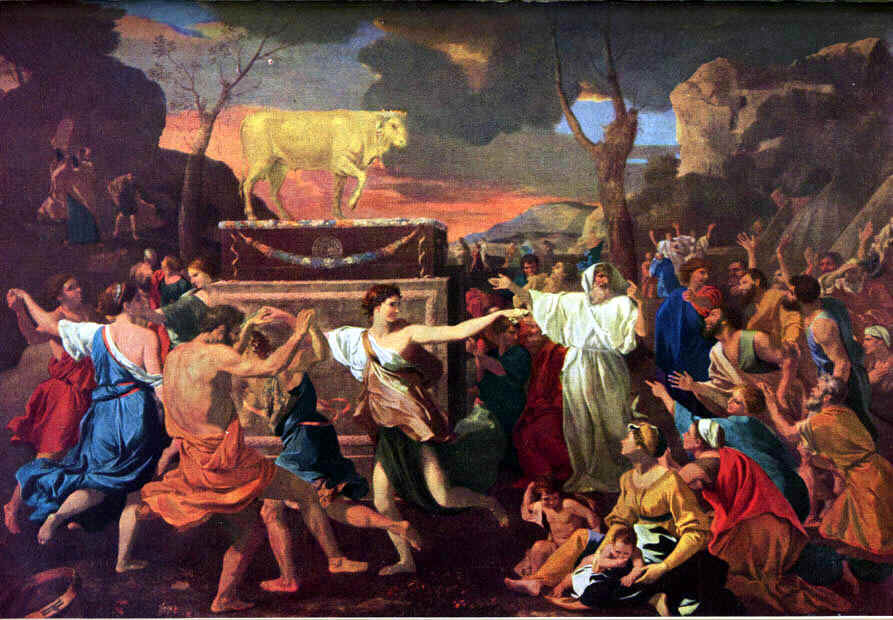
The Adoration of the Golden Calf by Nicolas Poussin [source]

Text adapted primarily from Deuteronomy 29 and 1 Kings 12.

8.21.2014

The Second Best Bible Story (Pt. II)

In an ancient night over 3000 years ago, a people was gathered in a camp at the base of a mountain.  Three months beforehand, they were slaves oppressed by a merciless king in a land not their own.  Their release from captivity was achieved by wonderful and devastating miracles; a land was cursed until these people were free.  Out of thin air and solid rock, God provided for their hunger and thirst.  And on a quiet night at the base of a mountain, God expressed in words a love his actions had already demonstrated to the people, saying:

You yourselves have seen what I did to Egypt, and how I carried you on eagles' wings and brought you to myself.  Now if you obey me full and keep my covenant, then out of all nations you will be my treasured possession.  Although the whole earth is mine, you will be for me a kingdom of priests and a holy nation... 

The people all responded together, "We will do everything the Lord has said."

Then the people took two days to purify themselves, and on the third day they went to the base of the mountain to meet their Lord.  God appeared in the morning as fire on the mountain cloaked by a thick cloud; the blast of a trumpet ushered in his coming.  Thunder boomed, lightning crashed, and the ground quaked beneath their feet.  Yet God was not fully revealed for the people would have perished in his unveiled presence.  Who could behold his holiness?  One man was able to ascend the mountain and approach the living God to learn all this people would need to know.  This was the marriage of God to a nation; a covenant of the people's faithfulness and God's unbridled love.

The man on the mountain had been gone for a long while.  The people began to suspect that he had perished on that flaming hill.  Fraught with uncertainty, they turned to the man's brother and begged for a new god.  Full of doubt himself, the brother collected all the gold earrings from every man, woman, and child in the camp and cast a calf with his hands and tools.  He declared, "This is your god who brought you up out of slavery."  He prepared a place to worship it and led the people to give offerings before it.  There was a raucous party, and the people indulged in food and drink to excess.  They danced unfettered before their crude idol.  But God saw them.  He sent the man on the mountain down to the people to put an end to this folly.  The man burned the handmade calf in a fire, ground the remains into a fine powder, and scattered the remains in the water.  He made the people drink the glittering water.  If they had been tempted to refashion their pseudo-god, it would be impossible to do so out of their own gold.  Then God said, "come to me," to anyone who would acknowledge him as the true God.  There was punishment for those who were unfaithful yet returned.  But for those who rejected his appeal there was only death.  

http://upload.wikimedia.org/wikipedia/commons/8/83/Moses_Rosselli.jpg
Tables of the Law with the Golden Calf by Cosimo Rosselli  [source]
It was time to move forward.  The camps were packed up and the people prepared for the journey ahead.  God would lead them to the home he had promised their ancestors.  His desire to do good for them had not wavered in spite of the people's betrayal.  And while God spoke generously of all he would provide (safety from their enemies, a fruitful land, and a prosperous future), the heart of God confessed he would distance himself from them.  Their waywardness had pushed their loving God away from his treasured possession.


Text adapted primarily from Exodus 19, 32, and 33.

7.30.2014

The Second Best Bible Story (Pt. I)

Everyone knows John 3:16~ for God so loved the world that he gave his one and only son that whoever believes in him shall not perish but have eternal life.  Most know that Jesus' death on a cross is the highest revelation of God's love for mankind.  We know that God loves us so dearly that he gave over his perfect son to an unspeakably grim death for imperfect us.  There is no greater action in the history of time that shows the love of the Father for his children.  But what if I were to ask you where I could read the second best demonstration of God's love in the Bible (specifically outside the life of Christ)?  I would like to submit to you that it is a story found in the pages between the Psalms and the gospels.  That least explored area of the Bible called prophecy where God's stories are removed from the confines of time, and reality is illustrated with curious imagery~ it's no wonder why prophecy is a challenge for any Bible reader.  But if you overlook these stories, you may have overlooked the second greatest story of God's love of all time.

He was a man of God.  She was raised secular.  They were wed and became parents to a little boy.  God named the boy "scattered".  She came to expect another baby, perhaps by someone other than her husband.  This time it was a girl God named "not loved".  A third pregnancy shrouded in unknown paternity led to the birth of a second boy.  God called him "not mine".  The marriage was put to the test, but the man of God loved his wife and the children she bore.

One day the man of God came home to find the children unattended.  Their mother had left with no indication of where she was going or when she'd return.  The man of God had an idea where she'd be-- off seeking satisfaction outside of their marriage.  She had left before but this time she wasn't coming back.  The reality of her departure solidified her rejection of her husband and children.  She exchanged it for fancy dinners and gifts from the company of untold numbers of men.  The man of God still loved his wife; what aching pain he must have felt trying to explain to his children that their family was "scattered, not loved, or not mine" to their mother.  What shame he must have felt as his friends began to realize how fitting his children's names were.  His grief must have weighed heavily on him.

Across town, the unfaithful wife was beginning to lose her charm.  Lovers lost interest and dismissed her.  She searched desperately for anyone who would just share a scrap of food in exchange for a place in their bed.  Her moral poverty became true poverty.

One day, the man of God heard how his wife was struggling.  He risked being rebuffed by her current paramour to take her some food, water, and clothes.  Confused by the husband's presence, this lousy lover gladly took the provisions only to pass them off as his own gifts to the wife.  And how she praised her lover wrongfully for this kindness as her husband listened in.  The true love of the husband had not reached the wife, and he returned home leaving her to her deluded and destructive ways.

The wife soon became so unlucky in love that she could find no man to take her in.  As she attempted to just forestall starvation, her debts began to mount.  This prodigal wife reflected on how much better off she was in her husband's home saying she will return to him.  But for some reason, she doesn't go.  Maybe she feels too much guilt.  Maybe she can't imagine how she's supposed to go back to being a full-time mother after living only for herself for so long.  Maybe she considers that they are better off without her.  She stayed put, and her indebtedness reached its nadir.

Her lenders had had enough; something must be done.  It was determined that she would be sold as a slave to try to recoup some of their losses.  She was taken to the center of the capital, lined up at the auction block with actual slaves, stripped naked, and offered to the highest bidder.  Except there was no highest bidder.  No old flames came to rescue their damsel in distress.  Her utter worthlessness was on full display-- until from out of the crowd she heard a familiar voice.  Her husband had come offering fifteen coins and a sack of animal feed for his bride.  She was valued at half the price of a common slave.  Legally her husband's purchase made him her master and her his property.

How foolish the man of God must have appeared.  More degrading that being cheated on and used as a meal ticket by his wife's lovers, he publicly paid for what was already rightfully his.  His friends must have thought it a terrible waste of money; after all, she had not indicated that she desired to turn from her wild ways.  Yet there he was, ready to love her and rescue her.

The man of God began to restore his wife.  At her purchase he clothed her as his wife-- not in the rags a slave would wear.  He told her that he was hers and she was his.  She must not seek any man besides him anymore.  Without condemning her, he required her to turn from her old life and live with him.  This is the story of a woman named "complete" who lived in complete depravity before she was made complete in love by her husband.  This is also the story of God's man, "the Lord saves", who lived up to the foolishly persistent and pursuing love of God in order to save the one he loved most.

http://graceelgin.org/images/Hos_HoseaGomer.jpg
Engraving of Hosea and Gomer by Matthäus Merian [source]

I received a tremendous amount of help from the following resources:
NIV Scofield Study Bible
Believer's Bible Commentary by William MacDonald
The Minor Prophets, Volume 1 by James Montgomery Boice
The Amazing Collection, Set 6: The Early Minor Prophets

Related Posts Plugin for WordPress, Blogger...