
"You yourselves know how we lived before and how we passed through the countries on the way here. You saw among them their worthless idols of wood and stone, of silver and gold. Make sure there is no one among you today whose heart turns away from the Lord our God to go and worship the gods of those countries; make sure there is no root among you for it produces such bitter poison.Faithfulness and undivided hearts to God were the requirement for receiving and keeping this new country. And so by God's leading and might, they settled in the land by battle and treaties with the people already there. The people held to God but gradually adopted the practices of their neighbors. The warning began to come true. Invasions and military confrontations threatened their peace, but a renewal of devotion to God led to restoration. In such times, God would raise a leader from among the people to protect them and remind them of the binding relationship they had with him. This age lasted for over three centuries.
"When such a person hears the words of his oath to God and they invoke a blessing on themselves, thinking, “I will be safe, even though I persist in going my own way,” they will bring disaster on the land. The Lord will never be willing to forgive them; his wrath and zeal will burn against them.
"All the nations will ask: 'Why has the Lord done this to this land? Why this fierce, burning anger?' And the answer will be: 'It is because this people abandoned the covenant of the Lord, the God of their ancestors, the covenant he made with them when he brought them out of slavery. They went off and worshiped other gods and bowed down to them, gods they did not know, gods he had not given them'...In furious anger and in great wrath the Lord will uproot them from this land and thrust them into another land."
New generations forgot the faithfulness of God; they had not experienced freedom from slavery nor had they been fed from the skies. They had not watched their numerous enemies defeated by miraculous events in battle. They had not remembered that the houses and vineyards they enjoyed were built and planted by the enemies of God for their provision. The people had wandering eyes. They began to look at neighboring countries and desire more than just their customs. They chose to practice idol worship with all the revelry and self-satisfaction those religions aroused. The people implemented a monarchy as other countries had. They still professed to love God, but how could it be with all these new allegiances? The people persisted in devoting themselves to lifestyles that pushed God out.
For a time God prospered his treasured people giving them kings and priests who honored him. Yet even the good kings failed to follow God wholeheartedly. Some priests even lost their way. And while the splendor of the nation was at its peak, the kingdom began to crumble. A rebellion arose dividing the nation in two. The smaller kingdom to the south had God's temple where the worship of the Lord continued.
The more populous kingdom to the north needed to distinguish its identity from what they had been. Their new king devised a plot to secure the people's loyalty and prevent them from returning to their former king and to the worship of the Lord. The king had two golden calves crafted placing them in two prominent towns. He invented a religion and arbitrarily selected priests to promote it. He fabricated shrines all over the land. He made counterfeits of the holidays God had established and selected dates and meanings for them randomly. The people followed his lead and gave offerings as if this were a legitimate religion. The king's betrayal to God was institutionalized and the people were deceived. When their hearts were devoted to inanimate objects instead of God, they intentionally discarded the oath they had made with God. This is how they purposefully forgot him to do as they pleased.
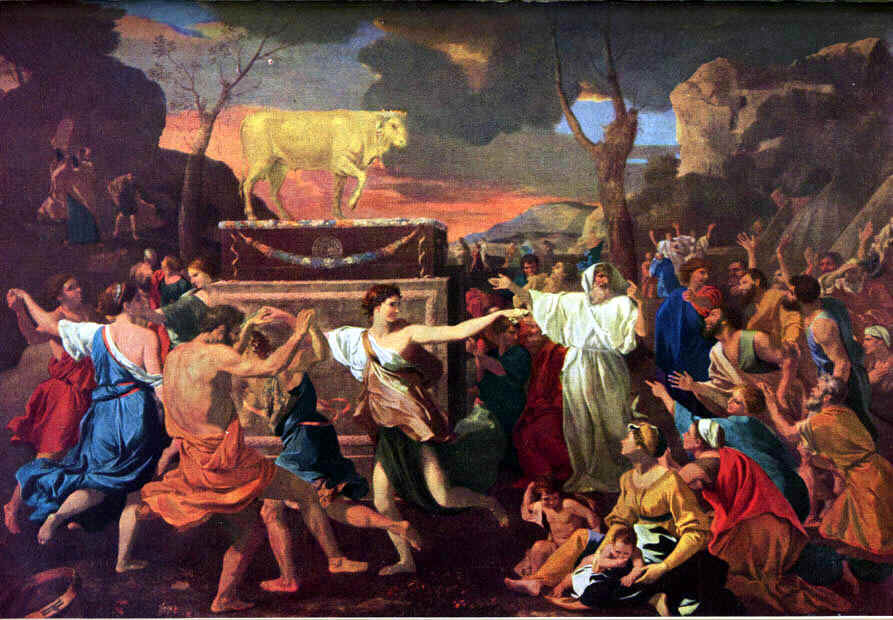 |
| The Adoration of the Golden Calf by Nicolas Poussin [source] |
Text adapted primarily from Deuteronomy 29 and 1 Kings 12.


